Review Youre Not Old Enough Son Barry Atkinson

I sometimes feel skeptical about fiction ready in the near future which presents how our society might devolve and disintegrate in dystopian ways. Is this really what volition happen? Ishiguro cannily avoided going into much detail about his projected future in "Klara and the Sunday" past showing information technology through a limited perspective. Alternatively, one of the reasons Diane Cook'southward "The New Wilderness" didn't piece of work for me was considering the way her social club had reorganized itself due to dwindling resources felt unrealistic. Lulu Allison takes an inventive method with her narrative which describes a near future England with littoral erosion, populations concentrated in cities, racist/homophobic clans, increasingly devastating pandemics and a United kingdom that'due south disbanded. One could easily argue that this is only a lightly exaggerated version of the country every bit it currently exists. Given the style things so rapidly changed because of the recent pandemic it sometimes feels similar the author is commenting on what's happening at present: "all of them, immature and former, know that the process of getting dorsum to normal is withal a long way off. It is called up similar a spell, or a prayer, the earnest expression of a shared desire that is experienced now mostly every bit a affair of faith rather than expectation." The story shows a gradually acknowledgement that whether we like information technology or not our order has been substantially altered because of viruses and climate change. Therefore, a collective desire for a return to a simpler contempo by is a wish that probably won't ever be fulfilled.
Alongside the primary story almost a rural male child named Jesse and a immature woman from London named Isolde, there are poetic descriptions of the transforming mural and a chorus of feral cows who collectively annotate upon the action. In this way the author creatively and energetically presents individuals searching for a sense of home and communities struggling to determine how to organize themselves within an increasingly strained environment. A pleasantly surprising aspect of this novel is the manner that Jesse and Isolde'south stories intersect with each other. Considering the narrative switches back and forth between their journeys, the author manipulates their relative fourth dimension periods and plots out when details are divulged to produce a wonderfully dramatic consequence. It gripped me and allowed me to feel an emotional attachment to a story which sometimes meandered into the pastoral. Nonetheless, it never grew too ponderous as idyllic descriptions of land life were balanced by inevitable disharmonize - even within an intentional community that strives towards harmony and self-sufficiency within the larger order. Initially I felt more engaged with Jesse'south story only, as the novel progresses, Isolde came to experience like the most adult character. Other characters such equally Jada and Lee don't experience like they get quite enough infinite in the narrative to become wholly rounded. However, this didn't detract from my overall enjoyment of the suspenseful aspect of this tale.
I specially appreciated how the author occasionally interjected short sections which depict the human history behind a decayed function of the physical landscape whether it be a aging house or an abandoned object. This gave small glimpses into other stories which briefly touch the main characters' narrative and the way different people are impacted by larger changes in the globe. It'due south likewise constructive the way the author presents the trauma and ongoing grief people feel: "Anybody carries these snap shots, these mosaic memories of the dead and dying." At that place's a building sense of the strain and fearfulness people experience which leads to groups of people growing increasingly distanced from each other and breakdowns in communication: "These rare settlements and the cities survive, by mutual consent, in avoidance of each other." Inevitably, this leads to serious conflict which culminates in rustic warfare inside the story. It shows how the author is in some ways more than concerned with demonstrating the psychological and social effects of the challenges nosotros face today rather than speculating on what lodge might look similar in the coming decades. In this way, the novel is both absorbing and provokes a lot of placidity reflection.

Information technology tin can sometimes exist difficult for people on the outside of an abusive human relationship to empathize why someone would remain in such a dangerous situation. Books such as "When I Striking You" and "In the Dream House" have provided dynamic points of view exploring this question which encompasses much more than toxic romance. Factors such as money, gender, civilization, religion, sexuality and psychology all play into why someone doesn't simply leave their habitation later being degraded, hit and/or raped. Alethea, the protagonist of Lisa Allen-Agostini's novel "The Bread the Devil Knead", gives some other important viewpoint. She's a Trinidadian woman who manages a vesture boutique in Port of Espana. She'south about to turn forty and she has lived with Leo for over five years. He's a former locally-famous musician who has come up to regularly beat out Alethea and controls her to the point where she has trivial social contact outside of work. Though she'due south a deeply private person, Alethea decides to share the nature of her abuse with a colleague one day. This confession combined with the return of 2 fundamental figures from her by and a deadly set on outside her shop create subbstantial changes in her life.
I immediately warmed to Alethea's independent nature and reserved sensibility. She frequently loses herself in books and it'due south enjoyable reading her commentary on several different authors she'southward read. Though I grew as concerned as the people around her who see her bruises every bit signs of an abusive relationship, I gradually become more than aware why the question of leaving Leo wasn't and then uncomplicated for her. On the surface she'southward cognizant of the social stigma around single women: "people does go on similar if you lot, every bit a woman, who accept no man, you non good plenty, similar you'southward non a real woman. So if is either stay with a asshole or take no man at all, I rather stay with a asshole." However, in that location are deeper factors to practice with her past being abused past her female parent and an uncle which gene into why she reacts to being beaten and controlled in the way that she does. Scenes from Alethea'due south childhood are interspersed with the present story to show how they continue to impact her. Readers should be aware that there are some disturbing scenes of abuse in the book. They aren't there to daze but to show how it affects Alethea's relationship with her own body, men and sex. I appreciated the way in which the writer artfully arranged these scenes within the novel to make this larger statement.
There are also some surprising revelations and occurrences in the story which brand it a thoroughly dramatic and engrossing read. At ane point, Alethea wryly comments that her life has more twists than a soap opera. Still, I fully bought her grapheme because her distinct personality and the tone of her Trinidadian voice felt so real. At times this meant the narrative became a little besides overloaded with her recounting small unnecessary details. Still, it also allows her space to reflect and point to larger issues such as colourism on the island: "Is withal a kind of racial, colour-conscious place where people who look similar me does get through when people who look similar he doesn't get i shit." The way in which people who accept different skin tones are treated in subtly different ways was also skilfully incorporated into the story. Information technology presents a complex portrait of a community. But the focus of this novel is always centred on Alethea herself. By the stop of the volume I became aware of how something every bit simple as her pick of surname could become so loaded with deeper implications and meaning. It'southward a moving delineation of one woman's difficult journey to independence.
Posted
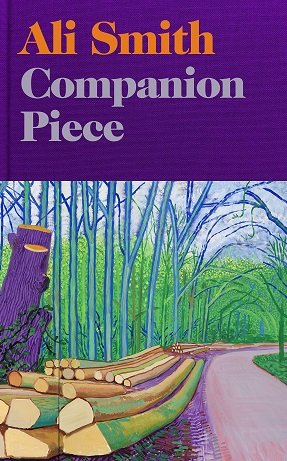
Amidst the tumult of the past four years it'south been a lotion when a new Ali Smith novel has annually appeared to herald in a new season, a new story and a new run into with this author's inspiring imagination. "Autumn", "Wintertime", "Spring" and "Summer" take provided an invaluable frame for our contempo times. So I felt worried when I read the beginning of her new novel "Companion Piece" which is described as beingness adjacent to the quartet or in the same family as this contempo group of books. A graphic symbol named Sandy states how "I didn't intendance what flavour information technology was... Everything was mulch of a mulchness to me correct then. I fifty-fifty despised myself for that bit of wordplay, though this was uncharacteristic, since all my life I'd loved language, it was my main grapheme, me its eternal loyal sidekick. But correct then even words and everything they could and couldn't do could fuck off and that was that." Oh no! Is Ali feeling so discouraged past the ongoing chaos in the globe that she'south feeling depleted? Well, frankly, who isn't? But, of class, the wondrous and surprising tale which continues on from this point shows that this author'south creativity is notwithstanding very much engaged and vibrantly active.
Sandy Grayness is an artist whose elderly father is unwell and in hospital but it's "non the virus." Visiting him is hard as this takes place in 2021 while the pandemic is still causing restrictions when entering hospitals and what contact is allowed. She'southward likewise desperate non to get sick herself and inadvertently pass information technology onto her male parent so Sandy is limiting her interactions with other people. Still, an unexpected call from an old classmate that she never even liked provokes a serial of events leading to Sandy'southward house existence colonized by a family that disrupts what's become her cautiously reserved existence. Those familiar with Smith's work will know that unexpected guests frequently appear and this novel is partly nearly what information technology ways to let other people enter your life fifty-fifty when yous don't want to interact with them. Given how isolated and distanced we've been from each other over recent years, this notion of letting others in is a challenge we all need to think nigh.
The invaders are not but individuals, but ghosts from the past. At i indicate a medieval girl and her bird come to steal Sandy'south boots. Does this actually occur or is information technology a dream? That's not the question which this narrative is concerned with because "If any of this ever happened, if either of them ever existed. One way or another, here they both are." Many more than fascinatingly strange things occur over the course of the story equally we're led to question not only the boundaries between people, communities and nations but between 1 menses of time and another. A clock smashes and forms back into a whole. People are being categorized, shepherded into confined spaces and branded in unlike ways today just as they were hundreds of years ago. The shape and course may change simply information technology's the same old story. This book is partly about that continuance, merely also the light and dark which tin be found in all these experiences. Nosotros may call the leaves of a tree green only they cover a range of shades and an space variety of colours. This is what Smith'south fiction celebrates.
We follow Sandy's development every bit disruptions in her life crusade her to open up, consider new possibilities and have new encounters. Coming together someone can entirely alter someone'south point of view. Companionship can be found in a unproblematic "hello." Sprightly dialogue is interspersed with poetry analysis in a way which sparks unanticipated connections and new meaning. If we're attentive enough to the globe effectually the states we tin see the mechanisms at play in linguistic communication, in the ways we are governed and in nature. As in the Seasonal quartet, there are too references to specific political and social events to non but testify to what occurred in 2021, merely remind us of what actually happened because so many news stories are headlines one day and forgotten the next. Sandy's journey doesn't only bring her to one destination simply allows her to see all the doors which are open to her. The novel beautifully shows that it'south okay to take time to be lone merely as it'south okay to reach out to course a new connection, but nosotros mustn't allow ourselves to become numb to what'south occurring around us or the possibilities bachelor to united states of america every twenty-four hours.
Posted

Information technology'due south a solemn fact of every kid'southward life that they are incapable of truly knowing what their parents' lives were like earlier they were born. To the child, parents are initially only known for their roles every bit parents rather than individuals (whatever the quality of their parenting.) In the offset office of Violaine Huisman'south debut novel the narrator describes her female parent'south manic behaviour caused by mental illness and societal constraints. Maman could exist loving to the signal of clinginess towards her and her sis. But she could likewise be abusive, cocky-destructive and maddeningly unhinged. She'southward as well beautiful, witty and charismatic. Given her volatile personality it's no wonder she became alienated from many people around her and her daughters grew to have such ambiguous feelings towards her. In an attempt to build a deeper understanding of her mother Catherine and "give her back her humanity", the narrator builds a work of fiction about her Maman'southward early life based on what she's been told and the (oftentimes contradictory) information about her. It's a loving projection which is full of drama and compassionate insight as we come to understand a more dynamic picture of this vibrant adult female'southward life.
It's striking how the narrator concedes this business relationship of her mother'southward life is a work of imagination but that she as well endeavours to be an impartial vessel to evangelize this story. If it was framed differently it might non have as much of an emotional resonance every bit it'due south an account of invention and speculation. However, I establish this to be a very moving novel and I think information technology's a balancing act which works so powerfully as a conscious act of empathy. Because it's established early on how challenging information technology was to grow upwards with Catherine every bit a mother, this story she creates becomes both a love letter and a gesture of forgiveness. Whatsoever child who has been a victim of parental abuse knows how difficult it is to move across the acrimony and pain felt towards parents that didn't nurture their child in the way they should have washed. In this way, this novel is maybe the antithesis of Avni Doshi'due south novel "Burnt Saccharide" which then powerfully describes an developed child'due south implacable fury towards a neglectful parent. By contrast, Huisman grants the female parent figure a kind of freedom by vividly describing the qualities and faults which made Catherine a fully rounded individual. It'south a beautiful and worthy project which builds to a uniquely poignant conclusion.
Posted

Be careful not to mistreat your books because they might talk back! Ozeki'south novel follows the story of boyish Benny who begins to hear voices after his father'due south death. He senses that these are coming from the inanimate objects effectually him. So he frequently takes refuge in a library because books are meliorate behaved than other things. His widowed mother is naturally very worried about her son. She also grapples with her own sense of loneliness, being fabricated redundant from her job and a hoarding trouble. There'southward also a looming threat from Benny'southward school, counsellors and social workers to accept him away and medicate him. Both mother and son run into some figures and come across literature which inspires them to question their human relationship with gild, material possessions and reality itself. As with her novel "A Tale for the Fourth dimension Being", Ozeki draws in concepts of Zen Buddhism to encourage her characters and readers to ponder meaningful philosophical questions.
Though the concept of this novel about talking objects sounds quite whimsical it takes seriously the emotional strife of a struggling single mother and her troubled teenage son. At that place are some truly heartbreaking scenes where she desperately tries to connect with her boy and sooth him merely to be rebuffed as he's embarrassed and feels misunderstood. While I did find this involving I ofttimes questioned the necessity of Ozeki'southward narrative device where the book becomes a character itself. Benny grows increasingly frustrated with the way information technology tells the story – especially when it gets into embarrassing detail about his female parent'south personal life. Certainly this is a creative approach for trying to convey Benny'due south feel of the earth, only I sometimes establish it detracted from my engagement with the story.
Similarly, at that place are parts of the book which felt like overt diatribes about materialism and consumer culture. It's not that I disagreed with Ozeki'southward points but they felt didactic because her lessons took prominence over her characters in some sections. This was especially true for an artistic character who calls herself The Aleph. Though I found it fun how she devised a game of planting clues in various library books to form a trail for readers to follow, she oft preaches about her behavior in a way which felt too pointed. The female parent also sometimes came across as overly naïve as if she was simply created as a receptacle for the wisdom that the writer wanted to impart. Perhaps I wouldn't have taken such umbrage with these issues if the novel weren't so long as it didn't feel like it needed to be over v hundred pages. I did enjoy many parts of the book. I just wish information technology had stuck more than to the emotional core of the story rather than creating so many flourishes.
Posted

The luxury housing complex at the centre of this novel is called Paradise, but groundskeeper Polo has trouble pronouncing this English word and so his employer orders him to say it phonetically equally "Paradais". Polo is trapped in this dead finish job where he's ordered to perform menial tasks for rich people. He's paid little and what coin he does make goes directly to his overbearing mother who makes him sleep on a palate on the floor. Polo's cousin lives with them and she may be pregnant with his infant. Outside of piece of work he spends time getting drunk with i of the older boys who lives in the complex named Franco, just Polo refers to him disparagingly as "fatboy". He's disgusted by Franco merely the boy steals quality alcohol or modest sums of money for Polo to buy them booze. The sour dynamic of this friendship of convenience is so vividly conveyed as the boys waste their fourth dimension together and hatch an evil plan. Franco has failed socially and academically so volition probably be sent to a military school. He becomes obsessed with his masturbatory fantasies about his female neighbour who is a mother. So they decide to break into the neighbour's home so Franco can force her to have sex activity with him and they can rob the holding. These are immature men who feel they have nothing to lose which makes them incredibly dangerous.
Equally with Melchor's novel "Hurricane Season" in that location is a hypnotic intensity to her prose which spills out in an almost stream of consciousness fashion. Nosotros're bombarded past Polo's sensory experience of the globe and his emotional interpretation of information technology. All the while we securely experience his growing resentment for the callous wealthy residents of this complex and anger well-nigh his limited options in life. This takes the class of long blocks of text and extended sentences. Information technology's a narrative construction which is entirely suited to carrying Polo'due south signal of view and made me feel trapped in information technology just as he feels ensnared by his circumstances. In this way it feels somewhat similar to Damon Galgut's technique in "The Promise" because while being locked into the perspective of this graphic symbol the reader is likewise implicated in his misogyny, bitterness and fury. While this can't exactly be called a pleasant feel it is so effective in carrying his worldview, his warped reasoning and his motivations. It made me feel empathy for him as he essentially doesn't seem similar a bad person. He's but overwhelmingly frustrated past his economic and social position in life. He's besides been raised to embody a pernicious form of masculinity. At the same time, I'chiliad repulsed by his attitude and decisions. Information technology's an effective manner of completely drawing me into this menacing character'south life.
I as well don't entirely trust Polo's perspective equally he frequently refers to most of the women around him as horny sluts and then I question whether his estimation of events and people are entirely accurate. Polo can clearly see that Franco'south neighbour would never be sexually interested in Franco, but Franco is convinced that she actually does want him. Similarly, Polo is certain his cousin is constantly flirting with him and tricking him into having sex with her so I'k cautious about accepting whether this is really the case. It brings an interesting level of ambivalence to this narrative which is saturated with a misogynistic attitude. Interestingly, there is likewise an intimidating female figure in the story whose power resides in her absence. This is a notorious long-expressionless tyrannical Countess rumoured to haunt her dilapidated mansion which Polo must appallingly pass past on his mode to the luxury housing complex. Just equally in "Hurricane Flavor" the just way women can escape this masculine-driven customs is to become a menacing almost mythological figure. I appreciated how Melchor incorporates the imagined spectre of the Countess' presence into the narrative as a counterpoint to these hyper-masculine points of view.
For such a short novel, "Paradais" makes a large impact and leaves a lasting impression.
Posted
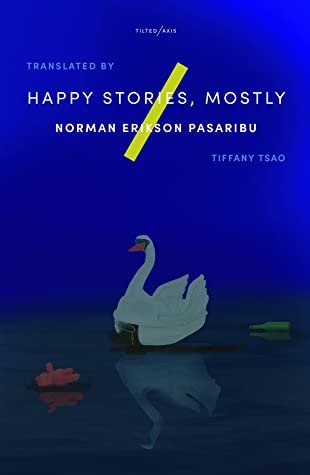
This group of short stories by Indonesian author Norman Erikson Pasaribu has a playful, metafictional vibe while evoking many vivid characters and situations that comprise a great deal of emotional heft. Many focus on the points of views of characters related to or connected with homosexuals whether information technology be a mother grieving for her son who committed suicide, a man whose shut friend turns out to exist gay or a woman who snoops through the underwear drawer of her son's husband. The feelings of marginalization and isolation which accompanies much of gay life is approached at arm'due south length. This sense is carried through the opening and closing stories which are in many ways about the nature of fiction itself. The kickoff story begins in a creative writing class. The last story concerns a woman aware she is existence written and finds empty space when she tries to transcend the borders of what is synthetic for her. All this ties into the presence of religion throughout the stories and questions concerning omnipotence, destiny and God. These tales collectively requite a fascinating insight into Indonesian life and individuals sidelined by mainstream guild.
As with many collections of stories, at that place were some which stood out equally stronger than others. Peradventure this has to do with the way there is an nigh equal partitioning between ones which depict specific realistic situations and others which self consciously play with narrative voice to verge more into the supernatural. I felt the strongest of the after category was ''Welcome to the Department of Unanswered Prayers' where the an individual is inducted into the bureaucracy of heaven. I would have loved to see stories such as 'Then What's Your Name, Sandra?' and 'Ad Maiorem Dei Gloriam' developed into longer narratives. I think it's easier for me to experience an immediate connectedness when the presence of the author's hand isn't so strongly felt. Though I really appreciate that the truth can't always exist approached direct, I wasn't able to connect as strongly to stories which seemed like they were in directly dialogue with sure texts or aspects of Indonesian life I was unfamiliar with. That's not necessarily the storyteller's mistake, but it'due south perhaps an inevitable consequence of reading about a strange civilization. And so I really appreciated that the Tilted Axis Printing edition of this collection included at the stop a give-and-take between the author and translator where they described some of the references Pasaribu played off from and his writing technique. I enjoyed the writer'southward innovative approach to these tales and would dearest to read a total novel written by him.
Posted

On a small, sparsely-populated and remote Irish gaelic island there is an ageing population that all the same speaks their native Irish language, but they are steadily dying out. Ane of the remaining youngest island residents is James who prefers to speak English and exist addressed past his English name rather than his Irish name Seamus. 2 foreigners separately travel to this isle for their own purposes. There is irascible London artist Lloyd who wants to create paintings that capture the island'southward beauty and its inhabitants. He hopes to produce great works that will institute him as the "Gauguin of the Northward". There's also Frenchman Jean-Pierre, a linguist who has been making excursions to the island for many years to record how the "purity" of this spoken linguistic communication is slowly changing with the increasing influence of English language. He wants to write an account of whether true Irishness can be preserved and Lloyd's presence is mucking up his plans. The two bicker and clash over their right to be on this isle. The bodily residents of the isle grudgingly tolerate both of them as they are paying guests who bring in much needed majuscule every bit the native angling industry has likewise been dying out – quite literally as both James' begetter and grandfather died at sea.
This is a ho-hum burning drama that builds to say something much bigger nearly notions of national purity and colonialism. I admire how Magee approaches this on a very human level – every bit she did in a very different set up of circumstances in her powerful debut novel "The Undertaking". This new novel opens with a very funny scene where Lloyd insists on being ferried out to the island via an outmoded form of gunkhole transport that's so rocky he's frequently sea sick. Even so, the middle of the novel is with the character of James who is defenseless between two worlds and whose opportunities are very narrow. He desperately wants to avert following the family tradition of condign a fisherman and finds a new passion in painting from his interactions with Lloyd. Information technology's and then moving how he develops an affinity for the spiky gentleman and what he tin offer him as Lloyd suggests the boy's natural talent might go down well in the London art scene. Conversely, James is repulsed past the attention of Jean-Pierre who tries to get James to employ his Irish name and preserve his native language. This all raises such strong questions about the meaning of national identity and who decides the fate of individuals and a distinct group of people.
Interspersed with the narrative about life on this island are short - most journalistic - accounts of victims of The Troubles. These brief glimpses into lives that take been destroyed take the sobering effect of showing how ordinary individuals and families suffer while problems to do with Irishness and colonization are being more violently fought over. Even on the remote outpost of this island this longstanding war touches its citizens. Though Lloyd and Jean-Pierre believe their presence is benign or donating, they have a pernicious impact on James who finds himself left in as hopeless a position every bit earlier they arrived. The same is true for James' mother who (against the wishes of her family and the customs) models for Lloyd and expresses her desire for a sense of permanence in Molly Bloom-esque soliloquies. The issue of this story is haunting. Its writing is and so finely tuned with dialogue which fully brings to life these characters and their points of difference. Magee conjures a sense of tragedy that is very moving and impactful.
Posted

I was especially slap-up to read "The Moonstone" since it's credited every bit having established many of the parameters and rules of the modern detective novel. Elements found in mysteries such as an English language country house setting, ruddy herrings, a clever investigator, a large number of suspects and a final plot twist might feel commonplace amid many books in this genre at present, but Collins' novel appears to have been one of the outset to successfully combine these into a thrilling story. It concerns a legendary Indian diamond that's bequeathed to Rachel, an heiress who first wears the stone at her lavish birthday party. Yet, it goes missing during the nighttime and it'due south disappearance concerns much more than than simple thievery. There are many side plots and dramatic occurrences within the story which gradually unravels to produce a surprising conclusion.
Information technology'due south no wonder this novel was a hit with the general public who read it in series form when it first appeared in Charles Dickens' magazine. Information technology was afterward published as a volume in 1868. Gabriel Betteredge, the household's head servant and the first narrator in this epistolary novel, is and so charming and sweetly funny. He frequently reads a copy of "Robinson Crusoe" and compulsively refers to information technology for guidance as if it were the bible. Betteredge also strikes up a friendship with Sergeant Cuff, the renowned detective who takes charge of solving the case. However, their relationship becomes strained as Gage'southward suspect list begins to include many members of the household including Rachel herself. I plant the down-to-earth quality of both these men actually endearing especially the way Cuff is really more interested in retiring and growing roses than he is in seeing justice served.
It'due south besides extremely entertaining reading the indicate of view of Rachel'southward poor cousin Drusilla Ballyhoo, the 2nd narrator of this story, equally she is extremely pious and evangelical most pressing her faith on those effectually her. But anybody firmly rebuffs her proselytizing and clearly considers her to be an annoyance. It'south clever how engaging Betteredge and Clack are as narrators while also laying out lots of vital clues to intrigue the reader. The plot really heats up going frontwards as we continue by post-obit Franklin Blake, one of Rachel's suitors. He seeks to untangle what actually went on during the dark of Rachel's party and clear his proper noun from the doubtable list as he appears to exist guilty. While I was delighted by the many twists in the story they did grow to experience increasingly ridiculous and impossible. Perhaps implausibility is as well a necessary chemical element of virtually detective stories considering they want to create a heightened sense of drama. Also, it's somewhat uncomfortable how a large part of this premise relies on colonial exoticism and an exaggerated sense of Indian mysticism with a group of disguised Hindu Brahmins lingering in the background every bit additional suspects.
Nevertheless, I thoroughly enjoyed the humour and excitement of this tale. It's genuinely thrilling too as emotionally engaging and so information technology was such a pleasure to read. I was excited to learn that Anthony Trollope created a parody of this novel with his book "The Eustace Diamonds". So I wait forward to reading that once I get to Trollope'southward "Palliser" series of novels. Trollope poked fun at Dickens in his novel "The Warden" with great comic effect and so he clearly enjoyed sending up some of the most pop fiction of the day. Even so, the influence of Collins' novel is irrefutably far reaching in how it set the standard for murder mystery stories. Though this tale is initially solely about a theft, bodies are discovered along the mode giving a heightened sense that the culprit is lurking around the corner and must be discovered earlier they strike once more.
Posted
It'southward the second big book prize announcement of the week! Hither are the 13 books nominated for this year's International Booker Prize. A new video is upward on my YouTube aqueduct discussing all these titles: https://world wide web.youtube.com/lookout man?five=paQELE_7QVU
I love that this award highlights the best new fiction translated into English and I've institute and then many new-to-me great authors through this award. With international relations in such a terrible and tense place at the moment it feels more important than ever to read stories of experiences and points of view from other countries.
These novels and collections of brusk stories were translated from 11 unlike languages and originated in 12 different countries. This year's prize has a good representation of stories from Asia which is hasn't always been the example in past years and it's wonderful to see. There are also a number of queer stories. There'southward also quite a Large divergence in page length! The shortest "Paradais" is 118 pages and the longest "The Books of Jakob" is 893 pages. Phew! I do want to read Olga Tokarczuk's new epic merely I'm on the fence most her writing since I didn't get on with "Flights" only really enjoyed "Drive Your Plow Over the Bones of the Dead".
I've currently read four books from this list: "More Than I Dearest My Life" by David Grossman, "Heaven" by Mieko Kawakami, "Love in the Large City" past Sang Immature Park and "Elena Knows" past Claudia Pineiro. They're all splendid and truly worthwhile reads! I do hope to read all the residual of the books at some point but don't take much hope of finishing the list before the shortlist is announced on April 7th. Probably the next book I'll read from this grouping is "Paradais" since I loved Melchor'south novel "Hurricane Season" so much.

What do you recall of the list? Are there any y'all're curious to read? Do you read much translated fiction?
Posted
The longlist for the 2022 Women's Prize has been appear! There are a lot of surprises and there are quite a few ghosts/spirits in these stories. I've posted a video on my YouTube channel discussing the 16 novels. In that location are at least four dubut novels. A number of these authors have been longlisted before including Rachel Elliot, Charlotte Mendelson, Leone Ross, Catherine Chidgey and Elif Shafak. There are a number of authors from the UK and America, but some come from Trinidad and Tobago, New Zealand and Turkey.
I'm especially thrilled to come across This I Sky Solar day past Leone Ross and Great Circle by Maggie Shipstead listed as these were two of my favourite novels that I read last year. I'm also delighted to see that The Paper Palace by Miranda Cowley Heller and The Island of Missing Trees by Elif Shafak are nominated. Given how much Anna described her dislike of Heller'due south novel in our predictions video, I'thousand sure there will be lots of expert debate about this book!

I'thousand excited to come across The Sentence by Louise Erdrich, Build Your Firm Around My Body past Violet Kupersmith, The Book of Form and Emptiness by Ruth Ozeki, Sorrow and Elation by Meg Bricklayer, The Final Revival of Opal & Nev past Dawnie Walton and The Exhibitionist past Charlotte Mendelson listed as I've been wanting to read these anyway. I'd not heard that Rachel Elliott has a new novel out but I actually enjoyed her previous novel Whispers Through a Megaphone (also Women'due south Prize longlisted) so I'm looking forrard to reading Flamingo. I'd not heard of the novels by Lisa Allen-Agostini, Lulu Allison, Kirsty Capes, Catherine Chidgey and Morowa Yejidé merely they all sound fascinating then it'due south wonderful that this list has tipped me off to books I probably wouldn't have encountered otherwise.
Currently I've only read iv books from this group. Before information technology was announced I didn't think I'd read the whole longlist, merely now I've looked through them all they sound really good. And then I'm going to aim to read all 16 before the shortlist is announced on Apr 27th only it'll depend on how busy I am. I might first by reading The Bread the Devil Knead or The Exhibitionist. It's definitely surprising that Emerge Rooney, Lauren Groff, Hanya Yanagihara and Honoree Fanonne Jeffers didn't brand the list.

What do you think of the longlist? Are you planning to read some or all the books nominated? Whatever books that yous're disappointed didn't brand the cut?
Let me know!
Posted

Who tin resist a story nearly a literary editor chancing upon a re-create of a novel that's been out of print for over three decades and hails it every bit a lost dystopian archetype? That's the seductive tale which accompanies the contempo republication of "They", a 1977 novel past a notorious figure from the 20th century literary scene. Though Kay Dick is barely remembered now, an obituary written for The Guardian in 2001 by Michael De-la-Noy makes her sound infamously unreliable, greenbacks-strapped and vindictive. Information technology's an ignominious stop for a adult female who was in one case George Orwell's editor and is chosen by Carmen Maria Machado "a trailblazing queer author." This new edition of the novel is likewise covered with a string of endorsements from Margaret Atwood, Eimear Mcbride and Claire-Louise Bennett. If I'g focusing more on the author'south reputation it'due south because I found myself more than interested in the author herself than the content of her novel.
By Machado'due south account, "They" is an unusual book amongst Dicks' slender oeuvre equally its cryptic stories describe a series of creative individuals beingness intimidated by an unnamed group who are watchful, destructive and intensely creepy. The painters, sculptors, musicians and writers who populate this novel revel in nature, thrive in having intellectual exchanges and delight in friendship. All the same, their individuality and desire to express themselves makes them a target for the menacing figures who hover in the altitude. These figures don't seem to belong to any one organization, simply represent a homogenized bullying grouping. The artists realise that "Nosotros represent danger. Non-conformity is an illness." They endeavour to find ways to cultivate their individual expression and exist on the margins of this repressive society even if some of them are punished, pillaged and have their memories wiped.
Though I appreciated the creepy tone to these stories and the eerie sense of being hemmed in, information technology was hard to become emotionally invested in any of the characters considering so few details are given about them or the nameless narrator(s). Instead we're just given snapshots of their behaviour wandering through the countryside walking their dogs or holing up together in places of refuge. The artists resent the figures in the distance non only for the way they terrorize them, only for their conformity in watching tv set and listening to pop music: "I could not endure the xc dB intensity of pop music that street megaphones related at such times." Equally, children by and large rove around in marauding groups to torture animals. From reading about the author'due south life and the way in which the society outside this civilized circle of friends is represented makes me experience that this perception is coming more from a curmudgeonly author's point of view rather than an invented grapheme'southward. Perhaps that's an unfair assumption, merely I came to experience every bit disquisitional of the pretensions of the artists as I did about the roughshod figures that intimidated them.
I think reviews which came out when this novel was first published describe this book every bit a fever dream. That feels like a much more than apt clarification than calling it a dystopian novel. Perhaps considering I came to it with that expectation I was more than disappointed because it felt quite unlike from any dystopian story I've read earlier. Perhaps that'south a good thing and perhaps the dystopian novel at present comes with expectations which are too limited. Notwithstanding, the style of "They" left me with little to grasp onto or retrieve. There are some lovely evocative descriptions: "The damp sharp smell of newly mown grass stirred areas of childhood memories." I admired the writing but it didn't build to a satisfying whole. The story could certainly be interpreted in many ways, but information technology felt besides ambiguous for me to feel impacted past information technology. Overall, I was left longing to read more most the author'southward life than to read more than of her fiction.
Posted
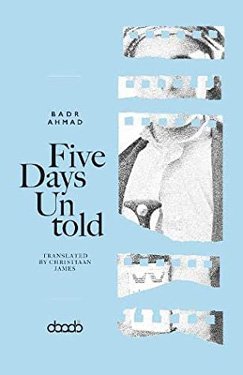
Several years agone I acted every bit an extra in a docudrama virtually a disharmonize in Afghanistan where I played a soldier. I was given a crash grade in military training and how to handle a real weapon which was only armed with blanks. When filming started I fumbled with my weapon and found it difficult to go along pace with the other actors equally they raced beyond the set re-enacting a war. The artillery practiced, coiffure and other actors got quite annoyed at what an incompetent soldier I made and it's condom to say my performance wasn't convincing. Luckily this was but a fictional state of affairs and I've not e'er been conscripted or made to perform compulsory war machine service. Ziad Al-Niqash, a young man who is ane of the central characters of "Five Days Untold", isn't so fortunate as an order delivered to his home commands him to join in the civil war occurring in his country. Though the specific location and conflict isn't named in the text, 1 can assume this is set during the ceremonious war in Yemen given the writer Badr Ahmad'due south nationality and because it takes identify over the New Twelvemonth of 2017-2018. We follow his harrowing journey beingness drawn into war machine service, the experiences of his family and the malicious plot of a local tyrant named Naji Awad. It'south a terrifying insight into what it ways to be a frightened boyfriend who is suddenly forced to be a solider.
There's a lot of pressure on Ziad at abode already since he is the only son of his family and his father is mentally and physically unwell. As, he's made to experience like he must work in a specific chore to support his family although his eye is drawn to a unlike kind of profession. So it'due south all the more heartbreaking when he's all of a sudden forced to become a soldier and he frantically wonders "how will I avert being killed? I was unable to process it all. I wasn't fabricated for this. I was created to draw and sculpt, to cultivate dazzler in modest corners, and to found delight in people's souls." The narrative follows the five days of his service which feels to him more than like a lifetime as he's immediately fearful for his life and he encounters numerous gruelling attacks. The way this is vividly presented is so moving and centre racing. It's powerful how the author portrays the psychologically and physically destructive effects of such an experience while Ziad badly clings to his humanity. At the aforementioned time, it's so fell how picayune he's valued equally an individual past many of the soldiers around him and how he'southward viewed as an absolute enemy past the opposing forces though he clearly didn't want to enlist in the start place. It's a devastating and impossible position to be in.
Though I appreciated how the author tried to also portray a politically-powerful human who is involved in dodgy arms dealing, I didn't recall the label of Naji Awad was equally convincing and his storyline seemed to belong more to a generic thriller. I don't doubt such cocky-interested and cruel people be, but the fashion the writer depicted his motivations for being such from his bad childhood to his impotence resulting from a auto crash injury was rather rushed. It likewise made me very uncomfortable how the extreme sexual violence inflicted upon his wife was dealt with in an as hasty style. In that location's a scene where she seems on the brink of exacting her revenge which felt quite confusing and his story plays out in a rickety over-dramatised way. For instance, at that place'due south a scene where he enters a trip the light fantastic studio and takes out a gun but eventually leaves without anyone at that place seeming to notice him. Though the tensions amid Ziad's family unit were handled somewhat better, I felt their unique story got swallowed upward in a clunky plot and lacked the temper present in the beau'south sections.
I profoundly appreciated reading a story from Yemen that concerns a disharmonize I've never read about in fiction before. However, I wish the novel had focused solely on Ziad'due south point of view every bit this was undoubtably the heart of the book. I'one thousand still grateful to take read this considering the manner information technology immerses you in the perspective of a young soldier is very impactful. Information technology's wonderful seeing more Arabic fiction being translated into English from the publisher Dar Arab.
Posted

It's been a while since a novel has consistently made me smile. "What You Can See From Here" has a wonderful lightness of touch to it while also being an emotional story which considers larger philosophical problems about the homo condition. It follows Luisa who, at the get-go of the novel, is an boyish daughter and we follow her into machismo. Moreover, it's the tale of the small West-High german village Luisa has grown upward in and the idiosyncratic members of this customs equally seen through her perspective. Luisa'southward grandmother Selma occasionally dreams of an okapi, an exotic African animate being that's similar a squashed-together version of several unlike animals. Whenever this creature features in her dreams someone in the area dies. So it's turned into an omen of death. At the showtime of the novel Selma has dreamed about an okapi again. Though they realise it's superstitious to believe a dream can signal such a tragedy, everyone in the village can't aid fearing it and tensely wondering who will be next. Rumours of the dream spread like wildfire effectually the community leading everyone to accept excessive precautions or set to meet their finish. When someone eventually does die information technology has a devastating event on Luisa and we follow her many years later on as she and the village are still dealing with this tragic loss.
Much of the delightful humour in this novel comes from the naturally amusing characters that populate it. Selma is a loving grandmother living in a slanted firm. The local optician is secretly in dear with Selma and begins many letters to her informing her of this but can't quite bring himself to consummate or deliver them. Luisa'south friend Martin dreams of being a champion weight-lifter and frequently picks Luisa up. Villagers flock to Luisa's eccentric great-aunt Elsbeth who makes homemade remedies for ailments or conditions. Luisa's female parent is perpetually late for any crucial event and her father is constantly absent as he's travelling the world. Marlies is a grumpy woman who lives in the nigh remote corner of the village like a melancholy Eeyore. Even the family canis familiaris Alaska comes bounding in and out of scenes knocking things over and making its presence known. The way in which all these disparate individuals with all their foibles and peculiarities come up together is handled in an endearing and loving way.
Another reason why this novel is and then funny is from the clever and engaging fashion information technology portrays the absurdity of life. Though we may accept grand ideals or try to follow the path of logic, we can't control our instinctive reactions to what we meet. And so the villagers allow themselves to abound fearful when Selma has her dream of an okapi though they know it's not rational. It's natural for our emotions to occasionally consume united states and the novel shows how this especially occurs when information technology comes to dear and death. In her adulthood Luisa has a hazard come across with a Buddhist monk named Frederik and develops a potent bond with him. Though information technology may seem like a very random thing to insert into the story, it makes sense how the principles of Buddhism are contrasted confronting man nature. Various concepts concerning the perception and natural of reality are raised betwixt the characters – though Frederik is more concerned with eating French fries than he is with discussing Buddhist texts. The story isn't mocking the religion but showing how challenging it is to free oneself from disruptive desires and an attachment to a limited, subjective understanding of the world. Whether a person is a Buddhist or non, these are big problems we all grapple with in one form or another. The novel poignantly demonstrates how these aspects of our nature are the very things which make us so beautifully man and bring together us together as a order.
Posted
Reimagining a classic novel is a risky concern. Some such equally "Gorsky" by Vesna Goldsworthy and "The Hope" by Damon Galgut have successfully borrowed plot lines from classics ("The Not bad Gatsby" and "Howard'south Cease" respectively) and transposed them to an entirely new setting and context. Even so, in that location is a danger that using the scaffolding of a pre-existing plot might inhibit a new story. For instance, I felt Craig'due south novel "The Golden Rule" needlessly forced in some elements of classic tales in a way which lessened the bear upon of the otherwise compelling characters and storyline.
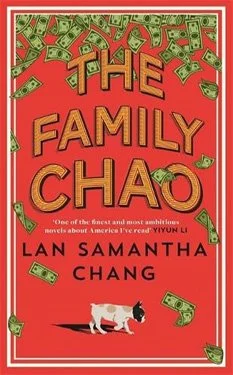
In "The Family Chao" Lan Samantha Chang gives a modern-twenty-four hour period retelling of "The Brothers Karamazov" to relate the story of a family with a domineering patriarch and iii very unlike Chinese-American sons. For decades the Fine Chao restaurant has been a fixture of the community, but disharmony is brewing backside closed doors. The youngest boy James returns to his family unit'south habitation in Wisconsin for Christmas to notice a lot of infighting. Though his eldest brother Dagou organizes a lavish feast and celebration at the family restaurant things don't go every bit planned. An explosive argument leads to Leo 'Big' Chao existence discovered expressionless in the meat freezer the side by side morning. Was this an blow or did something more sinister lead to his demise?
Fell gossip swirls effectually the family and the eldest son Dagou is put on trial for his father's murder. His two younger brothers Ming and James scramble to come to terms with their family'southward turbulent history and uncover what actually happened that fateful nighttime. With elements that include a dead stranger's travel bag filled with cash, an illegitimate kid's well-kept secrets, a missing dog and a murder trial this is a mystery that grows increasingly thrilling as it unfolds. Information technology'southward also a unique and meaningful tale which grapples with issues to practice with racism, corruption and greed. At the same time it is darkly funny, poignant and gripping.
Leo is rudely vicious in maintaining his dominance and ready to serve up whatever the public wants to feed their appetites and line his pockets. He succumbs to the American ideology that whatever is nigh assisting is also correct. Merely his sons have a decidedly different understanding of what it means to alive and survive in this country. What's more than telling is that the tragedy which occurs sparks public reactions showing deep-seeded stereotypes and biases. Though their state of affairs is unique and the brothers come armed with different points of view, they are churned into an ongoing discourse. Information technology takes honest reconciliations to excerpt themselves from this and persist in edifice their own lives. It's poignant the way in which Chang structures the novel to portray why this is such a struggle for this family. In its style and plot, she has successfully modernized and utilized elements of Dostoevsky's classic to tell a story which is uniquely American.
Posted
Source: https://lonesomereader.com/
0 Response to "Review Youre Not Old Enough Son Barry Atkinson"
Post a Comment