Is Chesley Sully Sullenberger a Reborn Again Christian
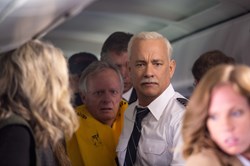
Image: Warner Bros.
Tom Hanks in 'Sully'
On Thursday, January 15, 2009, Twitter wasn't the virtual water cooler it is now, and so when New Yorkers heard that a plane had landed in the icy Hudson River, nosotros had to get to actual news sites to at-home our nerves. When it became articulate that there was no foul play on U.s.a. Airways Flying 1549, the pilot, Captain Chesley "Sully" Sullenberger, became an American hero overnight, fêted in the national press and the streets. Of the 155 people on board, he didn't lose one. "Miracle on the Hudson," indeed.
Simply no story of an American hero is as uncomplicated as it seems on the evening news. In the moving and remarkably restrained Sully, director Clint Eastwood digs into the reality behind the hagiography and presents a challenge to our collective tendency to make hero and celebrity interchangeable terms—all without discrediting Sully himself. This isn't the "untold story," the way we usually think nearly it: information technology's just a straightforward examination of what heroism really is.
Not that Sully (played here by the merely movie star I can imagine in the office, America's genial uncle Tom Hanks, with his hair dyed white) didn't deserve the accolades. As the film makes clear, his decades of flying planes—military planes and, somewhen, commercial jets—was the central cistron in his prophylactic, almost unimaginable landing. All the condom training and computerized flight simulators in the earth tin't compare to actual cockpit experience. And the movie's aim is to show you why that's truthful.
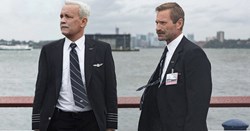
Image: Warner Bros.
Tom Hanks and Aaron Eckhart in 'Sully'
It also makes for a tremendous, taut viewing experience. In some ways this is the platonic "dad movie," and I hateful that in the best manner: a story nearly a guy who leaned on his years of experience rather than the numbers on a computer screen, and was right to do so. The movie starts subsequently the landing, and that's a good choice: we all know what happened, only the dual-timeline approach (the "present" afterward the result and the "past" upshot itself) sidesteps the ever-present problem of movies based on recent true events that lose steam because everyone knows how it ends. We circle back on the bodily landing several times, agreement what was going through Sully's head.
Perhaps the all-time thing about Sully is its restraint, near evident in its scoring. Eastwood cannily refrains from using music at all during the most intense moments, which is exactly right: a lesser film would have used music to tell you how to feel, only Sully trusts yous to know that you ought to feel worried for all 155 people on the plane, not to mention the city of New York. Zero here is overwrought. The real-life drama is real enough.
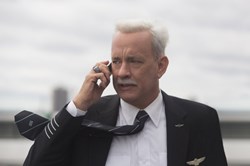
Image: Warner Bros.
Tom Hanks in 'Sully'
Information technology's also, in an unexpected way, the right motion picture to watch the weekend of the fifteenth ceremony of 9/11. (Especially as a New Yorker.) Sully functions similar a synecdoche for the events of that mean solar day, something the flick acknowledges quietly; there are several startling dream images of a airplane flying into buildings in Manhattan.
But the elementary, ordinary heroism of people who showed upwardly and did their job, echoed in the crew and passengers of the ferries and planes that responded to the needs of those onboard U.s. Air 1549, is a rebuke to a culture that rushes to valorize and demonize individuals (politicians, artists) and ignores the banal goodness enacted by ordinary people every day, the stuff that doesn't make headlines.
In a way, this has always been Clint Eastwood'southward aim. But how easily nosotros forget.
Caveat Spectator
Too scenes of peril (what did yous expect?), at that place are a few scattered profanities, as yous might imagine, including a couple of f-bombs. Merely in general, the film is appropriate for people mature plenty to experience the tense plane flight.
Alissa Wilkinson is Christianity Today's critic at large and an acquaintance professor of English language and humanities at The King's Higher in New York City. She is co-writer, with Robert Joustra, of How to Survive the Apocalypse: Zombies, Cylons, Faith, and Politics at the End of the World (Eerdmans). She tweets @alissamarie.
Source: https://www.christianitytoday.com/ct/2016/september-web-only/sully.html
0 Response to "Is Chesley Sully Sullenberger a Reborn Again Christian"
Post a Comment